Friday, June 25, 2021

Thank Goodness for Good Men Blogathon 2021!

~THE BEST BLOGATHON YOU'VE EVER SEEN IS HERE ~


After that momentous introduction I've set the bar pretty high, haven't I? I am supremely confident in the epicness of Anna's and mine and Megan Chappie's (of the Pen and the Cross) blogathon/blog party thingy-ma-bob (Yes, it is three words. Thingy. Ma. Bob.). 
This year of our Lord, 2021, is officially dedicated to St. Joseph and in honor of him and all the amazing and virtuous men who go unoticed all too often (real and fictional), Megan and I decided to host together a celebration of epic, righteous, honorable, virtuous, courageous and yes, good, men.


So here's how the papaya slices: as I stated in my original post about this blogathon and Megan in hers, your contribution to this celebration can be basically anything you want that's about cool and epic men. A character review (or two) of that special man, a list of your favorite male historical figures, a five thousand word essay on the beauty of responsible men (I'm not guaranteeing anyone will read it), anything you want! You can post your entry or entrees into thecomment section on ours or Megan's blog and they'll all be rounded up into a neat little list by the end of the blogathon. You'll also be able to see the many other posts by different bloggers that inevitably will be there, even if only Megan, Anna and myself participate... Do join in the fun and comraderie as we appreciate and honor the goodness of good men and thank God and His goodness for all they do and have done!

~ Anna and Irene

P.S. Feel free to grab any of the posters/banners either Anna or Megan have made and post them on your own blog.


Friday, May 28, 2021

I Confess (1953)

 Horseback to Byzantium's second blog entry into:


If you knew what he knew - what would you do?...


I Confess (1953)
Out of all of Alfred Hitchock's masterpieces, this one is probably my favorite. I feel like an insider to a mainstream 1950's movie (though not as mainstream as it should have been), and it's just so amazing. Beautiful and exact black and white cinematography, a haunting score, a unique and supsensful plot (I'm going to be using the word suspensful a lot here) and some great actors come together to make this a wonderful film. Not to mention, it's underrated, so that makes me like it even more, contrarian that I am. But why, you may ask, am I reviewing this for Catholic blog week? If you haven't already guessed from the title and picture, this movie is all about the sacrament of Confession and a priest so brave he wouldn't break the holy sacrament even to save his own neck. Now for a brief summary of the film:


-
Fr. Michael Logan, a Catholic priest living and serving his flock in Quebec, finds his faith challenged in a shocking way when one late night, whilst hearing the confession of German immigrant Otto, the man confesses to murdering a local wealthy banker. The seal of confession cannot be broken, and Fr. Logan is weighed down by his knowledge of the murder that he cannot reveal to the police. As if that wasn't enough, soon the stakes are raised. Fr. Logan himself is suspected of the murder and has no way to clear himself, and soon his past life comes back to haunt him and a motive of murder on account of blackmail becomes all too believable.
-
Once we showed this to our friend on a sunny afternoon when we felt like watching a movie, and when we mentioned it another day, she sad "Oh, isn't that the one with the hot priest?" Lolll I'm sorry, I just thought that was really funny and true. Anyway....
Since Alfred Hitchcock directed this movie, when I think of it and the moments that struck me, I can literally feel a chill. Some scenes just... were magical, in a dark way. Masterful would be a better word for it. Montgomery Clift is a masterful actor himself, and his eyes are so piercing that the way he looks when Otto reveals he murdered Mr. Rich-mean-banker is just like 'wow'. He carries the role of a man with a noble secret so well. I loooovvveee it when characters have something they just can't tell anyone and you know it's for a good cause and that it will cost them so much but they'll never tell because they're brave and everyone is trying so hard to get them to speak, but they just won't. I say this because I haaattteee it when characters have a secret that they really should tell and it's not that bad and they're just being silly and overly dramatic. I had to get that off my chest.
It seems that Montgomery Clift never changes his expressions noticibly, yet the subtle buildup of tension in the film is unmistakable.

Otto has piercing eyes as well, but creepy piercing eyes instead of beautiful piercing eyes.

So a couple days go by, an investigation ensues, and a tenacious police detective, played by an *excellent* Karl Malden, begins to suspect Fr. Logan for various reasons. He doesn't like to suspect a priest, but Fr. Logan does appear incredibly suspicious when he cannot account for his movements at a certain time of night that happened to be the time of the murder. And a man in a priest's cassock was seen near the scene of the crime by two young schoolgirls. Plus, he has a motive, which I will now tell you about in the messy part of the story. You see, at one time, Fr. Logan was........ IN LOVE!


It was before he became a priest, when he was young and Ruth (Anne Baxter's character) was just as young and almost as beautiful. But Michael (that's his first name) had to join the army and go off to fight in World War II, I believe. All this is showed to us in a mercifully brief flashback that I actually kind of enjoy. It's really dreamy and everyone looks beautiful and the music is lovely. I just close my eyes when they kiss. Long story short, Ruth thinks Logan is dead, and ends up marrying the man she works for, who is actually a very nice man. But Michael Logan WASN'T dead, and he comes back to Canada, looking for Ruth. She, in her joy at realizing her lost love is still alive, spends one entire magical day with him, without telling him she's married. Needless to say, we know this isn't gonna end well.
Caught in the rain, Ruth and Michael take cover under a little gazebo next to a house. They sit down and fall asleep at the table.
When they wake up, they see a man, the owner of the house apparently. He makes some crude insiuations about the two of them and reveals that Ruth is married. This man is the later-to-be-murdered-mean-old-banker... I should just look up his name.
Montgomery Clift looks so darn betrayed at this point, I just can't. He immediately breaks off their little rendezvous like a honorable man, and they don't see each other again, except in passing, because they awkwardly both live in Quebec.


As times goes on and Michael goes to seminary school and becomes a priest, Ruth and Michael's days together are mostly forgotten. Until Mr. Roberts (that's right, I looked it up) comes a-pokin' about Ruth's place, talking about what a shame it would be if her husband found out about a little affair she had with a man. Not just any man, but a priest! And KABAM. Next thing ya know, he's blackmailing her. Doesn't matter that Logan wasn't even a priest then and that nothing actually hanky-panky went on, he blackmails her anyway. 
And there you have Fr. Logan's motive.


I won't spoil anymore of the plot. Since the idenitity of the murderer is revealed early on in the story, this whole film is just suspense and more suspense.
Nothing (that I can think of) about Catholicism is misrepresented here and though Fr. Logan *did* run off to the seminary *after* he was left broken-hearted, it's clear that his heart is, when the film starts, in his vocation as a priest. He has no regrets, as is especially evident in his talks with Ruth. She obviously yearns for him, but he shows no such hankering after the forbidden. His path is laid out before him, and he does not wish to stray from it. God has put him there, and he wishes to serve God. 
Religion isn't mentioned too much in the film, but, as I said earlier, all is correct and as it should be. The center crisis of the film is brilliant and every single actor plays their part perfectly, just perfectly.
Watch for the part near the climax of the film, where Fr. Logan walks down the streets of Quebec, worn down by the secret he holds, and the theme piece of music grows louder and louder until Fr. Logan shows his frustration in one brief moment of exasperation. Absolutely beautiful direction. This is film making as it should be. 


This has been Horseback to Byzantium's second entry into the Catholic Blog Party, hosted by the Pen and the Cross and Bookshire
Irene signing out.


Tuesday, May 25, 2021

Irene's Top Ten Favorite Saints


Hellllllllooooooooooo!!!!!!!!!!!!!!!!!!!!!!!! I've been watching the calendar for this week since it was announced, for one simple reason. I want to talk about epic Catholic stuff! I'm pretty sure I'll be getting Anna to write a post of her own, and I'll be doing at least two. I mustn't forget to mention that this blog party/week is created by two great Catholic bloggers, Megan and Samantha. All the other Catholicy stuff will be on their blogs, compiled into neat little lists. My first blog post is not an easy one to create. My top ten favorite saints! I just want to say that this list has changed, and will change in the future. These are just the saints whom I find particularly epic and inspiring at the moment.


1. St. George
St. George is literally a legend. I have a soft spot for soldier saints, as the nobleness of fighting for one's country joins with the greater nobleness of fighting for God, and it makes the most epic combination ever. St. George is the patron saint of England and was born in Cappadocia sometime in the 200's, A.D. St. George was rasied a Christian. He became a soldier in the Roman army later in life, under the Emperor Diocletian, one of the most vicious Christian-killers of the Roman emperors. George was likely a member of the emperor's own personal bodyguards, a highly trained body of soldiers. George would not recant his Christian faith when ordered to by the pagan Romans, and so he was beheaded. Many different cultures tell of the many miracles in relation to St. George, and you can find a lot of them available for researching on line. St. George's legendary status reached especially great heights during the Crusades, and he is still one of the most famous saints in both the Eastern and Western churches. He is the patron saint of England. Here he is depicted as St. George, the Dragon-slayer, as he defeated Satan by holding onto his faith, even in death, and of course Satan is the Dragon, a symbol of utmost evil. I highly recommend the children's book 'Saint George and the Dragon', by Margaret Hodges. It is absolutely beautiful.


2. St. Irene the Great Martyr
I have to have St. Irene, my patron saint and namesake, on this list! St. Irene, born Penelope, was raised a pagan but was converted by her tutor Apellian, who himself was a Christian. He told her about Jesus Christ and she was soon baptized by a priest named Timothy and changed her name to Irene, which means peace in Greek. She then smashed all her father's pagan idols (#epic) and urged her parents to be baptized as well. This they did not like, and her father, Licinius, odered that she be trampled underfoot by horses. The horses would not do this and one of them rose up and attacked Licinius. Some sources say the horse killed him, some say he just brutally harmed him, but whichever it was, St. Irene prayed over her father and he was healed. Seeing this miracle, both Licinius and his wife converted to Christianity, as well as about three thousand other souls. St. Irene devoted her life to serving God and converting pagans, and the governor did not like this, so he subjected her to many tortures, but God protected his handmaid from them all. The governor thought this was sorcery. Hah! After Irene had been doing the Lord's work for a time, He revealed to her that her life would soon be over. She entered a tomb after making the sign of the Cross, and then told her friends to roll the stone over the entrance. They came back in four days and she was gone. God had lead her to heaven.


3. St. Moses the Black
St. Moses the Black was one terrible guy. He was born in Ethiopia and was a slave who was released by his master because he was suspected of theft and murder. He roved around doing generally terrible stuff, and whilst on the run from the authorities, took shelter in a monastery. The monks happiness and deep love of God touched him and he became one of them, converting to Christianity. Moses had a hard time adjusting to the contemplative life, and was discouraged when he discovered he would never become perfect enough. A fellow monk, Isidore, told him one morning as they sat watching the sun rise over the horizon, "Only slowly do the rays of the sun drive away the night and usher in a new day, and thus, only slowly does one become a perfect contemplative."
At the age of seventy five, St. Moses received word that a band of bandits were coming to attack the monastery. He ordered the other monks to retreat and not fight, but he deigned to stay, explaining that death at the point of the sword was fitting for a robber and murderer. Seven other monks stayed at the monastery with him and they were all martyred by the bandits. I'm afraid I would definitely try fighting the attacking bandits, but you have to admire St. Moses anyway, specifically for that reason. He is now among the great martyrs of heaven.


4. St. Alexander Schmorell, the Passion Bearer
Anybody who has read my blog before knows I absolutely love this man, and I've written about him several times. Here's a link to his biography, by me, and the letters of Sophie and Hans Scholl, where he appears briefly.
Yet I cannot sing his praises enough. Alexander Schmorell has the advantage of living less than a hundred years ago, so information regarding his character and life is more readily available that that of many early Christian saints. He was a beautiful human being, bringing light to all he came into contact with. He fought the nazis to the bitter end and died for God and fellow man. And guys, he took long walks in the rain and helped random ladies carry their groceries! A genuinely beautiful soul who we should all emulate. The scroll on the icon says, "One thing above all I urge upon you: do not forget God!"


5. St. Magnus Erlendsson, Earl of Orkney
St. Magnus was a literal viking! His life story is wonderfully recounted in a book by Susan Peek called 'Saint Magnus: The Last Viking', which I encourage you all to read. I thought a good deal of the tale of Saint Magnus was fiction when I read Susan Peek's book, but on looking it up, it's almost all historically available! I don't recall all the details, but raised in the Orkney Islands by his father who was an Earl of the Orkney Islands and ruled jointly with his brother Paal, Magnus was described in historical text as 'a quiet sort of man'. His home was attacked when Magnus was young and he was kidnapped and went through many trails that make an unbelievably exciting tale. He was always a Christian, pious and gentle, and was mocked by the Norwegians, who of course viewed gentleness as weakness and cowardice. He was beheaded as a young man by his own cousin, who had grown to hate him because of his lust for power. Magnus prayed for the souls of his executioners just before he died, and the rocky hill where he was buried became a green field after he was laid to rest and white flowers sprouted where his blood fell. He was killed on Easter Sunday. His life is like a political intrigue drama, dashed with high seas adventure and at the center of it all, strong, stolid, pious Magnus, a true viking saint.


6. St. Nicholas of Japan
St. Nicholas was a Russian Orthodox priest who was the first man to bring Eastern Christianity to Japan in a meaningful way. He volunteered to go to Japan and studied dilligently the Japanese culture and language. He studied Buddhisim for the first eight years of his life in Japan where, in his words, he, “strove with all diligence to study Japanese history, religion, and the spirit of the Japanese people”.
An absolutely fabulous occasion occured when he was at the consulate chapel in Japan. He converted three Japanese men, one of which was a former samurai and Shinto priest named Sawabe Takuma. Mr. Takuma had actually come to the home of Fr. Nicholas in order to kill him! After he converted, Sawabe Takuma became one of the first Orthodox priests in Japan. St. Nicholas had an incredibly hard time during the Russo-Japanese war. He was urged to return to Russia, but he stayed in Japan and helped the Japanese people as well as Russian prisoners of war. The Japanese government required that priests prayed, during the liturgy, not only for the safety of Japan's soldiers, but for their victory and the defeat of their enemy. This lead Fr. Nicholas to perform no public liturgies during the war. He could not pray for the defeat of Russia. All in Japan, including the Emperor Meiji, were impressed by Fr. Nicholas' holiness and diplomatic skills. He converted thousands of Japanese and translated the liturgy and many parts of the bible into Japanese. He died in 1912 and is venerated as the first member of the Japanese Orthodox Church.


7. St. Mary of Egypt
Mary of Egypt was a prostitute who revelled in her business. She was so debased and godless that she often did not even request money for her services. She merely did it for the pleasure of satiating her passions. It happened that she joined a pilgrimage to Jerusalem, a pilgrimage going to the the Holy Land to celebrate the feast of the Exaltation of the Holy Cross. She said that she went on a sort of 'anti-pilgrimage', to continue her promiscuous way of life and lead pilgrims astray. She lived in Jerusalem for awhile, continuing her evil ways, until one day she saw many people entering the Church of the Holy Sepulchre for the great feast and so she attempted to follow them in. But she was barred from entering by an unseen force. She then saw an icon of the Theotokos and bowed down to it in remorse, repenting of her sins sincerely. A voice appeared on the air and said "If you cross the Jordan, you will find glorious rest." And so St. Mary of Egypt became an aescetic and lived in the desert the rest of her days, praying for forgiveness. There is so much more to her life story, but this post is already long. She is the patron saint of chastity, deliverance from demons, and many other attributes and virtues.


8. St. John Chrysostom
One of the most famous and revered fathers of the church, St. John Chrysostom's name means 'golden-mouth', a fitting title for one famed for his preaching and inspiring homilies. St. John lived in Antioch and was an incredibly popular bishop who did not shrink from the task of condemning sin and evil, even when it was dangerous to his safety. He condemned the Empress Eudoxia for having a silver statue made of herself and placing it directly outside the Hagia Sophia. 
The first time he was exiled from Constantinople an earthquake shook the city. St. John died in exile, but not before he had written many beautiful homilies and letters, as well as the divine liturgy which we use today in our church. Also, as an extra note of epicness, St. John is credited with leading a group of Christians to destroy the temple of Artemis, one of the seven ancient wonders of the world. St. Cyril of Alexandria referred to him as "the destroyer of demons and overthrower of the temple of Diana." I don't usually approve of burning down buildings, but that was epic as heck.


9. St. Valentine
The legend himself, St. Valentine. I won't write a lot about this 3rd century saint of Rome, but I wanted to note him, as he is one of my favorite saints, probably because of his uniqueness. A saint that falls in love with a person as well as God is unique indeed, and the story of Valentine and the judge's daughter is beautiful and worthy of its place in the annals of time. Needless to say, both the judge's (some sources say jailer's) daughter and St. Valentine were martyred for their love of Christ and the Saint before Valentine was somehow cast out of our modern world, and now he's commemorated by the secular world by a secular day of love, even though he had the deepest love imaginable for his God, as well as for the girl he loved. It's a shame people don't know about the man behind the holiday. Sighhhh. You can read more about him on Wikipedia and other websites, and you definitely should. He's a wonderful saint.


10. Blessed Martyr Theodore Romzha
This saint is amazing for a lot for reasons, and one of them is that he's a Ruthenian Greek Catholic saint. Like, how often do we get represented like that? Never, that's how often! Anyway, Holy and Blessed Theodore Romzha was born in Austria-Hungary. After he completed his time in the Gymansium (kind of like high school) Theodore entered the seminary. He was ordained a priest on Christmas Day of 1936. This was during the time of the USSR, the communist terror. The communists did not appreciate Christians. Not at all. At the young age of 33, Theodore was consecrated a bishop. He immediately had to face the Red Army, who were occupying Catholic churches and assigning them to the Russian Orthodox Church (they didn't like the Orthodox either, but whatever). Bishop Romzha was asked to break with the pope and he refused. He organized a celebration for the feast of the Dormition which would contain about 80,000 pilgrims, but this was not allowed by the communists. They began to plot his demise. On his way home one night in a horse-drawn carriage, Blessed Theodore was hit (purposely) by a Soviet truck. The soldiers, dressed as civilians, came out and beat Theodore and his companions. A real civilian truck came driving by and the soldiers fled. Theodore and his companions were taken to a nearby hospital. Rhomza was recovering, when one fateful night, the nuns who had been nursing him were dismissed and replaced by a new nurse. A little after midnight, Bishop Romzha was dead, murdered by the NKVD. A man of his faith and holiness could not be allowed to live. He is commemorated on the thirteenth of October, the day he was martyred. 


And there you have it folks, my ten most favoritist saints as of May, 2021 A.D. Holy men and women deserve recognition, as they are the strongest among us. God bless you and keep you in the palm of his hand :)

This has been Horseback to Byzantium's first entry into Catholic Blog Week.


Wednesday, April 21, 2021

Tortured Soul by Theresa Linden

                                                  A Review of Theresa Linden's


A supernatural thriller about a lady's visions of a soul from purgatory who appears in an empty house in the countryside and won't go away. Fun stuff, not gonna lie.
-
Basically, a woman in her early thirties, Jeannie Lyons, is unceremoniously kicked out of her home by her older brother and moves to a home in the country. Jeannie is lonely and unsatisfied with life, and she has an inability to relinquish the memory of her dead parents, whom she loved very deeply. Her brother, Erwin, is concerned that she will end up living the rest of her life as a single cat lady, possibly with psychiatric problems and a dash of schizophrenia. Jeannie's niece once saw her dearly beloved aunt talking to the vision of Jeannie's dead mom, and the frightened little girl told this to Erwin's wife and himself. Erwin, with a quickly growing family, is determined that a new house and maybe a decent guy will snap Jeannie out of her tendency to live in the past and maybe give her something to look forward to in the future. Except the new house he finds for her is anything but helpful in the endeavor for mental stability and happiness, as Jeannie begins to hear noises every night. It is not long before a dark figure appears at six o'clock in the morning and six o'clock at night, frightening Jeannie nearly to death and causing her to question her sanity. Who is this ghastly specter, what does he want, and what should Jeannie do?
-
I was irritated for the first two or three chapters of this book. I have read all of the books in the wonderful West Brothers series by Theresa Linden, and I really liked them (even loved some of them), so my expectations were high.
But by the time I had been introduced to Jeannie, her family, and her troubles, I was growing annoyed at the fact that I hated everyone in her family and found her tendency to frequent emotional breakdowns exasperating, to say the least. Her niece Danita is scared of every darn thing and her nephew Gabriel finds delight in taking advantage of this fact, tormenting his sister whenever he can. Neither is disciplined, and their mother and the wife of Erwin, Trella, has the audacity to be angry at Jeannie when Jeannie is more concerned with the well-being of her heirloom lamp than she is with her niece's (or nephew's) arm when the little monster runs and break the poor old lamp. Gosh darn it woman, I wouldn't care about the little brat either! Needs a slappity slap slap.
Now that my frustration and harsh heart and abusive tendencies have been brought to the fore front, I'll bring you the good news about this book. The annoying family soon goes away and the book takes a exciting and terrifying turn. The noises start, as well as Jeannie's bed being shaken and waking her from sleep. A dark shape appear in the corner of Jeannie's bedroom, a shape that blends into the drapes almost completely. Jeannie's first reaction to to this is not to politely ask the good ghost what his business is in her house, but to run out of the room at light speed. I cannot blame her. I went to the bathroom after I read a chapter or six of this book and I must say, I saw movement in every crease of the shower curtain, in every roll of the towel. I would've been too scared too sleep, but I was so tired I fell asleep before I could convince myself to be afraid of the dark. Anyway, I will try to restore structure to this review.
Because Erwin fears his little sister will lead an ever lonely and miserable existence if she does not try to get a grip on her life soon, he makes it his duty to set her up with a gentleman named Oliver. Oliver was one of my favorite aspects of the story, as it doesn't seem when you first meet him that he will be an important character. More likely just a comic sideshow. He's not bad looking, slightly awkward, has a beard and loves photography. He carries his camera with him everywhere and he meets Jeannie when Erwin invites him over to the family house for dinner. Jeannie immediately discounts him as a love interest possibility, and so we do too. Very well played on the author's part, I must say. He helps Erwin with Jeannie's move to the new house in the country, and Jeannie is slightly concerned that he has feelings for her. She briefly attempts to think of a gentle yet firm way to tell him he's okay, but not her type. Yet when the ghostly occurrences begin, Oliver is the only one to believe Jeannie. Her sister refers her to a counselor, her brother says she has an overactive imagination and needs to get a grip, and even her priest suggests professional help is needed and has a hard time believing her fantastic tales. Oliver knows Jeannie is not crazy. And he also knows that there is life after this life, and although generally people from the next life don't come visiting this one, these things do happen.

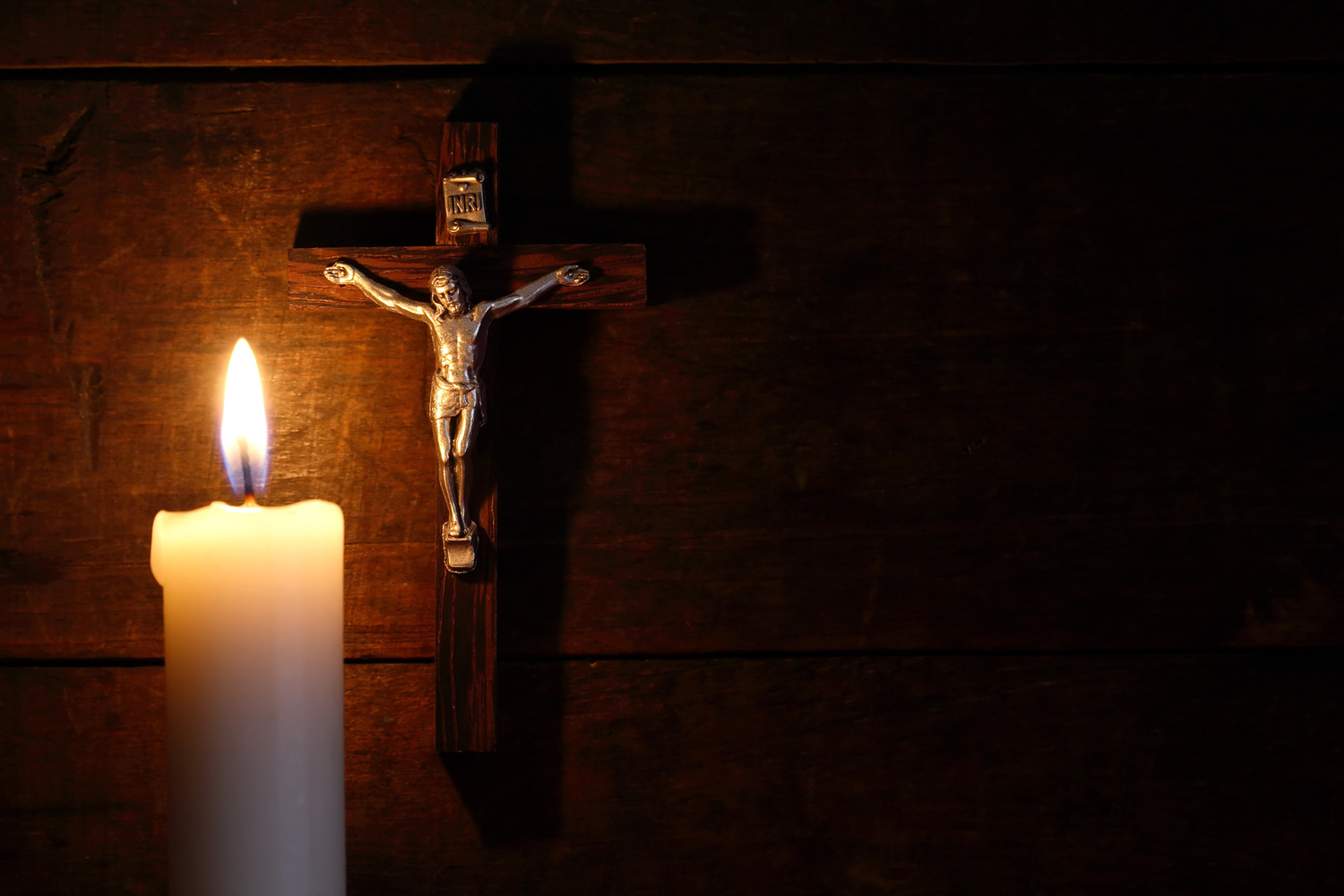
   Crucifix — Catholic Sacramentals

The next time the ghost comes to visit, Jeannie forces herself to observe him. He does not seem evil, but his pathetic, miserable and otherworldly presence is too much too bear, and so Jeannie once again fails to discover why this specter continues to visit her and banishes him from her sight.
As time goes on and the visits continue, Jeannie, with the help of ever helpful and protective Oliver, begins to unveil a startling story and starts to realize that when she prays for the souls of the dead, she doesn't understand what is happening. She doesn't understand that though she goes to church every week and fancies she loves God, her own soul is a mess of bitterness and a lack of forgiveness. She hold onto the past and neglects the present and the only way to banish the absolutely terrifying ghost is to become a real Christian, with all the trimmings. 
The apparitions to Jeannie in this book are based on the real life visions of purgatory that appeared to Eugenie von der Leyen, a German mystic from the 1800's. Excluding biblical examples and teachings, purgatory has always been one of the most logical teachings of the Catholic church to me. Nothing unclean enters heaven. There are those who cannot enter heaven, and yet it seems unbelievable for them to go to Hell. Those who see God just before they die, who repent, must have somewhere to go, and so in purgatory their evil works are burned up and they are cleansed through fire and the prayers, requests to God pleaded by others. Makes sense.
Tortured Soul is incredibly enjoyable and it makes me happy that someone is writing about purgatory, a strangely forgotten place and teaching of the Church, though it should not be. I think it is not mere coincidence that no one thinks about the poor souls locked in purgatory, pleading for our prayers, because they cannot pray themselves. The Devil doesn't like it when we sincerely think about the not-yet-lost souls and purposefully ask God to deliver them. He doesn't like it at all. I don't think the book has achieved the status of Great Modern Art (like that of The Golden Princess and the Moon), but it is an inspiration to all Christians and an exciting supernatural thriller that homeschoolers like me can read without having too many nightmares for weeks to come. I enjoyed it immensely, and I think you will too.
Until next time, God bless you and make sure you don't move into creepy big houses in the middle of the woods by yourself. There are always ghosts there, without fail. Better safe than sorry, I always (never) say.

~ Irene


Friday, April 16, 2021

Thank Goodness for Good Men Blogathon 2021


Hey there ladies and gents! We (that's right, Anna is helping), are pleased to announce a collaboration with Megan Chappie of The Pen and the Cross in a brand new blogathon, Thank Goodness for Good Men! It will take place from June 25th to June 28th, 2021. Megan over there on her blog did a nice little announcement explaining the whole deal, but I'll also do a little explanation. The following posters are the one's Megan made, and the one above is the one Anna made.


Inspired by 2021 being the year of St. Joseph, we decided to dedicate a whole blogathon to the subject of good and righteous men. You can write a character examination of a favorite fictional male character and what makes them special and good, a post about a saint or other historical figure, or just a list gushing about all the best men you ever seen in T.V. shows. Whatever you want!


Feel free to take any of the buttons we or Megan made and post them everywhere on your own blog if you have one!
We are excited for this, and this'll be Anna's and mine first blogathon (that we've hosted/cohosted) so make sure you join so we don't feel like failures. It'll be a lot of fun, I know. 
There will also be a Catholic Blog Week from May 23rd to May 30th, so make sure you check that out as well. The details are on The Pen and the Cross.


St. Joseph, Terror of Demons, pray for us ☦


Thursday, April 1, 2021

The Gulag Archipelago Vol.1 by Alexander Solzhenitsyn

 My Thoughts On:


Me trying to explain this is like a flea standing on the bank of Lake Superior and trying to swallow her waters. Very vast. Very depressing. Very impressive. 
Alexander Solzhenitsyn explains in three volumes (I've only read the first as of yet), each volume six to seven hundred pages, the madness of Soviet Russia.
What is an archipelago? Wikipedia defines it as 'A chain, cluster or collection of islands, or sometimes a sea containing a small number of scattered island.' Solzhenitsyn explains the great prison structure of the USSR as if it were an archipelago, a chain of gulags stretched out across Russia surrounded by an ocean of absolute misery. He himself was a victim of the prison system for many years, and during his time there, he strived to remember everything. The people, the places, the treatment of the prisoners, everything.


Ah, Communism. We must crush the petty bourgeoisie, we must elevate the poor worker. No, not the worker, the working class! Here we are all one, one great mass! And in order to elevate the downtrodden, well, a few sacrifices must be made. After all, our cause is just. 
That's the darn thing about communism. We're helping the working class, and the next thing you know, you're walking fifteen miles through the Siberian snow in the dark back to your unheated cattle car with maybe nothing but sandals on your frozen feet, no food in your stomach, and don't even think about water. What's wrong with the snow? And you must wonder: if everyone here, one's compatriots in prison, are all just unfortunate collateral, in the way of the communist utopia, then who is left to enjoy the utopia?
Not the estimated tens, likely hundreds, of millions dead, that's for sure.


I had trouble understanding some sections of this book, mostly those that involved the law and lots of Russian names and places (that's enough to confuse anyone) but the parts describing the the arrests, the interrogations, the tortures, and the prison are easy enough to understand, although not to comprehend. It's insane, completely and utterly insane. Everybody knows about Nazi Germany and its concentration camps, but fewer and fewer people are around who could tell you what a Gulag is. The Soviet Union was arguably worse than Nazi Germany. As Solzhenitsyn explains somewhere in the book, in this Communist utopia, there was never a question of guilt or innocence. In Hitler's Germany, a woman was tortured and interrogated and if, after many days she did not answer the questions given to her, they might let her go. She did not know what they wanted to know. In the USSR, your interrogators never expected you to know anything. That wasn't the point. The only point was terror and utter domination of the Russian people. 
Solzhenitsyn is a very brilliant writer, and achieved a level of perception about the world and people that hopefully none of us will achieve until we are dead. Here are some excerpts from the book I liked or thought were particularly illuminating:

'And how can you bring it home to them? By an inspiration? By a vision? A dream? Brothers! People! Why has life been given you? In the deep, deaf stillness of midnight, the doors of the death cells are being swung open - and great-souled people are being dragged out to be shot. On all the railroads of the country this very minute, right now, people who have just been fed salt herring are licking their dry lips with bitter tongues. They dream of the happiness of stretching out one's legs and of the relief one feels after going to the toilet. In Orotukan the earth thaws only in summer and only to the depth of three feet - and only then can they bury the bones of those who died during the winter. And you have the right to arrange your own life under the blue sky and the hot sun, to get a drink of water, to stretch, to travel wherever you like without a convoy.
-
And then a little bit later:
-
If your back isn't broken, if your feet can walk, if both arms can bend, if both eyes see, and if both ears hear, then whom should you envy? And why? Our envy of others devours us most of all. Rub your eyes and purify your heart - and prize above all else in the world those who love you and who wish you well. Do not hurt them or scold them, and never part from any of them in ager; after all, you simply do not know: it might be your last act before your arrest, and that will be how you are imprinted in their memory!
-
And here we have the description of Communism supreme:
-
"Where are our things?" they cried. "Your things you left at home!" some chief or other bellowed at them. "In camp nothing belongs to you. Here in camp we have communism! Forward march leader!"
And if it was "communism," then what was there for them to object to? That is what they had dedicated their lives to.

Until next time, God bless you and keep you safe.

~Irene


Wednesday, March 24, 2021

Fanny by Gaslight (1944)


Fanny by Gaslight, also known as Man of Evil in the United States (both terrible titles) is what they tell me is a melodrama, so I must say I am rather embarrassed to admit that I like it. Don't be confused by the title's similarity to the more famous movie 'Gaslight' that came out in the same year, starring Ingrid Bergman. Both are good movies, but I'm here to talk about the one starring Phyllis Calvert today. Now I shall attempt to summarize a pretty complex plot. Also, I hereby warn of spoilers ahead. Ahem:
~
Fanny Hopwood has lived apart from her parents at a boarding school since she was a young girl, but now, on her nineteenth birthday, Fanny is returning to her London home. The happy homecoming she expects is horrendously shattered when Fanny's father is pushed into the way of an oncoming carriage and killed during a street brawl. Soon after, Fanny's mother dies, but not before she learns that the Hopwoods are not her biological parents but her foster parents, commissioned to care for her by a man who is her true father. Due to the clandestine nature of Fanny's conception and birth, the girl's real father chose to keep her existence a secret after his unmarried love died. Fanny is quite at a loss as to what to do with her life, her respectability tainted on one hand by her foster father's questionable business affairs regarding the ownership of a house of ill repute, and on the other hand by her true parentage. She continuously searches for her place in life and happiness, but always is dogged by her past and a wicked man who seems to appear everywhere she goes
~
The plot to this story twists and turns, a narrative tale with Fanny as the catalyst. She fills her role with a strong resemblance to that of Oliver Twist and David Copperfield. Although Fanny does not have a great deal of character, she is still a sympathetic enough heroine to draw interest and, well, sympathy. And I don't think that she was meant to be chock full of character either. Everything about her seems like it shouldn't be any different, seems comfortable in its place. She just goes trotting through the story so we can see what happens next, and it always happens to her, whatever it is.


From the movie's start, I was always wondering what was going to happen next, and I didn't always get it right. A lot of lower budget films in the 40's and 50's that I have seen (and some higher budget ones too) are predictable to the point of ridiculous. I love certain cliches, but some are just not okay. Of course, this happens in modern movies as well, I just don't watch that many modern movies, so I can't really speak on that. Fanny by Gaslight has many components of a typical melodrama (I wouldn't know of course, because I don't watch melodramas, but if I did...), such as a damsel in distress, a man who impugns her honor, secret love affairs, and a generally sad aura, but it's a very unique film in my opinion. Another point to the movie was that no two characters were alike. Each actor played his or her part to perfection. I was delighted to see Margaretta Scott playing the unloving wife of Fanny's real father. Her name is Alicia Seymour. She plays Mrs. Pumphrey in All Creatures Great and Small! It was amazing to see her so young, and she has a very interesting and layered character indeed. Selfish but not cruel, light-hearted and flighty, but willing to give her heart away and fall hard for a jerk. A jerk who is not her husband, what's more! 


Fanny becomes her maid for a short time, never letting on that she is secretly Mr. Seymour's own daughter. She masquerades as a family servant's niece. 
This proves to cause a great deal of changes in Fanny's life, and around her. Whilst on a little vacation with her father in the countryside, Fanny meets Mr. Somerford. He is played by a young Stewart Granger. Tall, elegant, witty, gentlemanly, what's not to like? I saw a reviewer on the internet dare to say that his performance was wooden. I suppose she meant he was so strong and consistent and trustworthy that he fit the description 'Strong as an oak' so well that she couldn't help but think of him as made of wood. I'm sure that's what she meant. Couldn't be anything else.


Can you see how he's the best??? And now, if you've taken notice of the man to the right in the middle picture, we come to whom many believe to be the toast of the film and the toast of the town in the film, the wickedly evil and notorious Lord Manderstoke, played by the delightfully gross James Mason. I'm not saying James Mason is always delightfully gross, he just does a good job of it when he tries. Lord Manderstoke is not only a man who lives to do nothing but satiate his carnal desires, but he is also the man who pushed Fanny's foster father into the way of the oncoming carriage and caused his death. He was never punished for it. He appears everywhere Fanny goes. He haunts her like a ghost. My favorite thing about this character is that no matter where he is, no matter who he's with, if he sees a woman within ten feet of himself he will try to kiss her. It's honestly repulsive, not gonna lie.


An entertaining movie all 'round, I encourage you - no- I implore you to go watch Fanny by Gaslight, if you so desire. Although not a perfect film, I think overall the makers and actors involved did a splendid job and it should have more recognition. Until we meet again, God Bless you and make sure you watch lots of Victorian melodramas.

~ Irene


A cute picture, in my opinion.